The Flight to Houston: A Friend Said Frank Matthews Came Here. Then the Trail Went Silent for 53 Years.
In the first days after Frank 'Black Caesar' Matthews skipped bail in Brooklyn in 1973, a friend told investigators the fugitive and his girlfriend had flown to Houston. It was the first reported move of the most hunted man in America. It has never been confirmed, never explained — and nothing has ever surfaced behind it. Space City Daily separates what the record holds from what the legend added.
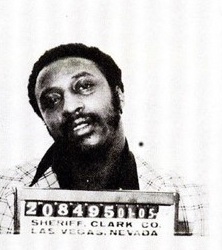
CASE FILE — Subject: Frank Larry Matthews, known as 'Black Caesar,' born February 13, 1944, in Durham, North Carolina. Charged with: conspiracy to distribute heroin and cocaine, attempting to sell about 40 pounds of cocaine, and six counts of federal tax evasion; he faced up to 55 years in prison if convicted on all counts. He was never tried. Last confirmed trace: about a month after he vanished, when IRS agents acting on a tip rushed to a North Carolina bank and the manager told them, 'Oh, you just missed him.' Status: fugitive. The federal bench warrant issued against him on July 3, 1973, is described in the court-record summaries as still outstanding. If he is alive, he is 82 years old.

Start with the only Houston sentence in the record. The Mob Museum's account of the case — the standard public retelling, built on Ron Chepesiuk's research for his book Black Caesar — gives it a single line: after Matthews and his girlfriend, Cheryl Denise Brown, vanished in the summer of 1973, 'a friend reported that Matthews and Brown took a flight to Houston.' No flight number. No date more precise than the first days of the manhunt. No named witness, no airline record, no follow-up in print. In the fifty-three years since, no Houston address, hotel register, sighting report or local record of any kind has ever been produced to stand behind it. The first reported movement of the most wanted fugitive in the United States points at this city — and the paper trail behind it is one sentence long.
What can be said about the report is mostly what surrounds it. It reached investigators in the opening days of the search, in the same weeks when the federal machinery was moving fast enough to put IRS agents in front of a North Carolina bank manager on a tip — which means the Houston report arrived while the trail was hours and days old, in front of agencies that were checking everything, and it still produced nothing that has ever entered the public record. What a flight to Houston would have meant in 1973 is inference, and this desk labels it as such: Houston was a booming oil city and a major air crossroads, a plausible place to change planes, buy distance from New York, or turn south. Plausible is all it is. The legend layer that later grew over the report is easier to document than the report itself: claimed-sighting lists in later retellings sometimes add Houston to the itinerary, and a rumor repeated in the lore holds that Matthews once had a heart transplant in this city. No record of any kind has ever been produced for either claim. They are folklore, and they are printed here as folklore.
To understand why one sentence could matter, you have to understand who was on the plane — if he was. Matthews was a seventh-grade dropout from Durham who ran numbers in Philadelphia and then out of a Brooklyn barbershop before moving into heroin in 1965. Turned away when he sought entry into the Gambino and Bonanno crime families, he went around them: through Harlem numbers operator Spanish Raymond Marquez he reached Cuban dealer Roland Gonzalez, and when Gonzalez fled to Venezuela in 1969 he became Matthews's supplier, feeding him heroin and cocaine from South America and, through the Corsican pipeline behind the French Connection, from Marseille. By the early 1970s the organization Matthews built — staffed, by his own insistence, with Black and Latino underbosses rather than Mafia partners — reached twenty-one states. Its Brooklyn cutting mills included one the organization called the Ponderosa; its couriers included airline stewardesses paid about $1,000 a month to carry heroin in flight bags to airport lockers. In 1971 Matthews chaired a summit of major traffickers in Atlanta that agreed, in effect, to take the import business out of the Mafia's hands, and he chaired another gathering in Las Vegas in 1972. Law enforcement estimated his 1971 income at $100 million. A dealer told investigators of a closet in Matthews's home packed to eye level with cash. He lived in a mansion on Todt Hill, Staten Island, in the same enclave as Gambino boss Paul Castellano — a neighbor the Mafia had never invited and could not control.
The money had a source, and the source had an address: the neighborhoods his network supplied. Federal agents estimated that in 1969 and 1970 alone the organization moved 100 to 150 kilograms of heroin into New York. One buying gang, investigators found, was selling some 17,500 bags a day to as many as 10,000 retail customers. The heroin that made Matthews rich fed the epidemic that was hollowing out Harlem and the other Black communities his organization served, and the trade around him was violent — in Philadelphia, the Black Mafia killed three of his lieutenants in a territorial war, and in New York vigilante groups took to shooting pushers on sight. Chepesiuk, who spent six years researching the case, put it without decoration: the narcotics Matthews peddled 'had a devastating impact on the neighborhood.' Any honest file on Black Caesar keeps that paragraph near the front.
The end began with a neighbor. In 1969 an NYPD detective named Joe Kowalski moved into Matthews's Brooklyn apartment building, watched the luxury cars and the visitors carrying paper bags, and started writing down license plates. His work fed a federal task force. A June 1972 wiretap exposed the stewardess pipeline and mapped the network by telephone; that November, Matthews's Cuban connection George Ramos was arrested and cooperated with a federal grand jury. Agents arrested Matthews at Las Vegas's McCarran airport in January 1973 as he was about to board a flight to Los Angeles, and an IRS agent informed him that he owed back taxes on $100 million earned in 1971 alone. A Las Vegas magistrate set bail at $5 million — the highest figure in American history to that day. Four months later, after his transfer to New York, Judge Anthony J. Travia reduced the bail to $325,000, over the government's warning that Matthews was a flight risk. A federal investigator who watched him leave the courtroom recalled the parting words: 'We'll see you.' Friends and relatives posted the bond, backed by their own real estate.
He was right, in the worst way. Out on bail, Matthews was spotted by IRS investigators back among big-time dealers at one of Harlem's biggest gambling rooms. In late June he disappeared, and on July 2, 1973, he failed to appear in Brooklyn federal court to answer a superseding indictment. Judge Travia issued a bench warrant the next day, and the U.S. Attorney ordered a full search. Brown vanished with him, and authorities believed he carried as much as $20 million in laundered cash. The New York Times reported that after jumping bail, Matthews reimbursed in full the friends who had put up the collateral for his bond — a fugitive who settled his debts on the way out the door. Then came the only two traces the record actually holds: the friend's report of a flight to Houston, and, about a month later, the North Carolina bank, where IRS agents acting on a tip were told, 'Oh, you just missed him.' After that, nothing. No fingerprints, no confirmed sighting, no recorded contact with family members. The Mob Museum's summary of the federal record reads like a list of absences, because it is one.
The newly formed Drug Enforcement Administration put a price on him — reported at the time between $20,000 and $25,000, the biggest federal reward since the Dillinger bounty of 1931 — and later raised it to $50,000. It was never collected. Reported sightings accumulated from Nigeria, Rome, the Bahamas and Bonaire to Chicago, Philadelphia, Atlanta and Pittsburgh; agents checked them and verified none of them. Around the turn of the century, the DEA commissioned forensic sculptor Frank Bender — whose aged bust of family killer John List had helped end that manhunt — to model what Matthews might look like after twenty-seven years on the run. The bust produced nothing. Lew Rice, who headed the DEA's Philadelphia office and later its New York office, reopened the file personally. 'Matthews was the big one who got away,' Rice said. 'We will never close the case.'
His organization was tried without him. Eighteen members of it were indicted in February 1975. The case that reached a jury ran ten weeks and heard forty witnesses, and eight defendants were convicted of conspiracy — among them Barbara Hinton, the mother of Matthews's three sons, whose conviction the Second Circuit later reversed because the government had indicted her before the same grand jury that had heard her immunized testimony. In the court record of that appeal, United States v. Matthews, the man himself is listed the way he remains listed: as a fugitive. Hinton never remarried, and by every published account she never gave the authorities a word about him. Even the paper did not survive intact: when Chepesiuk went to the National Archives for the trial records, the Archives searched thoroughly and could not find them.
So: is he alive? The honest inventory is short. There is no body, no grave, no death certificate, no confirmed sighting, and the reward was never claimed — not by an associate, not by anyone, in fifty-three years. Against survival: Chepesiuk, after six years on the case, concluded that Matthews is likely dead, and a former U.S. Marshals Service agent who handled the case has said the same. A man who lived as loudly as Matthews did does not obviously become a man who never once slips. For survival, there is the silence itself. Every other kingpin of his generation — Frank Lucas, Nicky Barnes — was arrested, tried and accounted for. Matthews's file contains no ending of any kind, and Brown was never heard from again either, which does not explain the silence so much as deepen it. If he lived, he turned 82 this February. If he died, he died unrecorded. The record, as it stands, cannot decide between those two sentences.
Where the case stands now: Matthews remains charged and untried in the federal court in Brooklyn, under a bench warrant issued on July 3, 1973 that the court-record summaries describe as outstanding. This desk checked the public record before publication. Online reports that appeared in December 2025 claimed federal authorities had 'officially ended' the search, but those reports rest on entertainment and secondary websites, cite no statement from the DEA, the Justice Department or the FBI, and sit alongside other retellings that date a supposed closure to 2012. No statement from any federal agency confirming the end of the Matthews search could be found in the public record as of tonight. Space City Daily therefore reports the case the way the federal record itself leaves it: open, unresolved, and still the longest disappearance in the DEA's history. The Investigations Desk will track the file for any official change of status — and for anything, anywhere, that ever stands behind one sentence about a flight to Houston.